What Is the Average Bra Size for a 15-Year-Old?
Somewhere between hand-me-down training bras and a drawer full of ones that pinch, dig, or gap, most 15-year-olds hit the same wall: nothing fits quite right anymore, and nobody can tell them what size they’re supposed to be. That’s because there isn’t one correct answer. Bodies at this age are moving targets, not fixed points, and band and cup measurements can shift more than once before graduation.
The real question isn’t what “average” means here. It’s how to get an accurate measurement right now, understand why the range is so wide, and know when it’s time to check again.

Key Takeaways
- Most 15-year-olds fall somewhere between a 30A and a 34C, but that’s a wide range covering a lot of completely normal bodies, not a target to hit.
- Breast development timing varies by genetics, body composition, and ethnicity, so two 15-year-olds can look totally different and both be right on track.
- Band size (the number) and cup size (the letter) work as a pair. A cup letter only means something relative to the band it’s attached to.
- Bra size at 15 is rarely stable. Expect it to shift again within a year or two as growth continues.
- A home measurement with a soft tape gets most teens within one size of correct, and a professional fitting settles anything in between.
- If a bra digs, gaps, or rides up, the fix is almost always a different band or cup, not a smaller size overall.
What Is the Average Bra Size for a 15-Year-Old?
Most 15-year-olds land somewhere between a 30A and a 34C, with 32B and 32C showing up most often across teen-specific size charts. That range is wide on purpose. Breast development varies enormously at this age, and band size depends on rib cage frame as much as anything else.
A properly fitted bra sits level around the ribcage and encloses breast tissue without gapping or spilling, and that fit test matters far more than any number on the tag. The fastest way to find her actual size is to measure directly rather than guess from age or from what a friend wears, using a bra size calculator alongside the step-by-step measuring guide for teenagers.
Why Is There No Single “Normal” Size at This Age?
There’s no single normal size at 15 because puberty doesn’t run on a fixed schedule. Genetics and body composition, not age alone, determine when and how much breast tissue develops, which is why two girls in the same class can be years apart in development and both be entirely healthy.
A longitudinal cohort of more than 1,200 girls found the median age of breast development onset ranged from 8.8 to 9.7 years depending on race and ethnicity, with the overall span running from 8 to 13. Biro et al., Pediatrics, 2013
Because that starting point already varies by several years, it makes sense that girls who are all 15 chronologically can be at completely different stages physically. Some are still in early development, filling out a first bra. Others reached their fuller adult proportions two or three years earlier. Neither pace says anything about what her body will look like at 20.
What Determines Band and Cup Size During These Years?
Band size comes from rib cage circumference, and cup size comes from breast tissue volume relative to that band. The two grow on separate timelines during the teen years, which is exactly why a bra that fit perfectly six months ago can suddenly feel wrong in only one dimension.
Sister sizing describes two bra sizes that share the same cup volume but use a different band width. A 34B has roughly the same cup capacity as a 32C or a 36A. It’s the easiest way to fine-tune a fit when the cup feels right but the band doesn’t, which comes up constantly for teens whose rib cage and breast tissue aren’t always growing at the same rate.
How Does Bra Size Typically Change Between Ages 13 and 17?
Bra size typically shifts across the teen years in a fairly predictable pattern, even though the exact size at any point still varies widely from girl to girl. The table below reflects the general patterns that teen-specific brands and fitters commonly describe, not a fixed rule for any individual body.
| Age Range | Typical Band Range | Typical Cup Range | What’s Usually Happening |
| 13–14 | 28–32 | AA–B | Rapid tissue growth begins; some asymmetry between breasts is common |
| 15–16 | 30–34 | A–C | Growth continues at a slower, steadier pace than early puberty |
| 17+ | 32–36 | B–D | Development largely settles into more stable adult proportions |
Puberty’s overall timeline has also been shifting earlier over recent decades. The median age at first period among U.S. girls dropped to 11.9 in a 2013–2017 national survey, down from 12.1 in 1995. National Center for Health Statistics, 2020
A 15-year-old’s bra size today is a snapshot of where her body is right now, not a verdict on where it’s headed.
How Should You Measure a 15-Year-Old for a Bra?
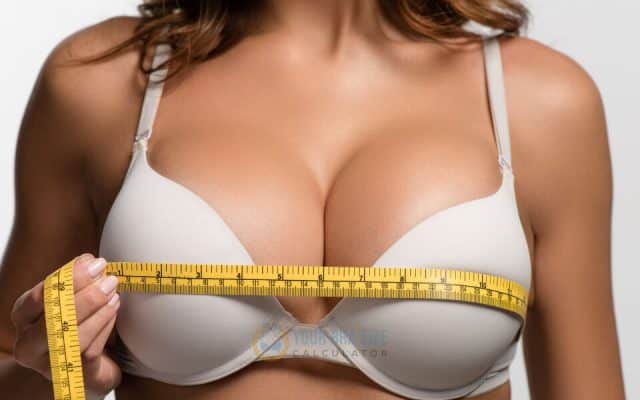
Measuring accurately takes two numbers: a band measurement snug around the ribcage directly under the bust, and a bust measurement around the fullest part of the chest with the tape parallel to the floor. The difference between those two numbers, in inches, points to a cup letter, while the band number comes from the first measurement rounded to the nearest even number.
Measure over a well-fitting bra or thin fabric rather than bare skin for a more realistic reading, and remeasure every few months since growth at this age moves fast. The full teen measuring walkthrough covers positioning and common measuring mistakes in more depth, and the band and bust calculator turns those two numbers into a size instantly.
What If Her Measurements Fall Between Two Sizes?
Falling between two sizes is common and usually means the band and cup aren’t both correct in the same size at once. When the cup fits but the band feels loose or tight, moving a band size and adjusting the cup letter to match, using the sister-size logic above, almost always solves it without changing how much room she has up top.
The band does the supporting. The cup just holds the shape. Get the band right first, every time.
Does Country or Brand Change What “Her Size” Means?
Yes, and it trips up a lot of shoppers. US and UK band numbers match directly (a 32 is a 32 in both), while EU and other international systems use centimeter-based band numbers that look completely different for the same physical size.
| Region | Band Sizing | Cup Letters (up to D) |
| US | Inches (28, 30, 32, 34…) | A, B, C, D |
| UK | Inches, same numbers as US | A, B, C, D (diverges above DD) |
| EU | Centimeters (roughly US band + 38) | A, B, C, D |
| Australia | Inches, same numbers as US/UK | A, B, C, D (follows UK above D) |
So a US 32B converts to roughly a 70B in EU sizing, not the 80B sometimes floating around online. Cup letters only start to diverge meaningfully once you get past a D cup, which covers the vast majority of 15-year-olds. For sizes and brands that fall outside this range, the full country-by-country conversion guide walks through French, Japanese, and Australian sizing in more detail.
What Are the Signs a 15-Year-Old’s Current Bra No Longer Fits?
A too-tight band pushes tissue toward the armpit and back, showing up as bulging at the sides or a band that rides up between the shoulder blades within an hour of putting it on. A cup that’s too small shows up as spillage over the top or sides, while a cup that’s too large leaves loose, wrinkled fabric with nothing to fill it.
Straps that dig into the shoulders or slip down constantly usually point to a band that’s doing too little of the work, since a snug band should carry most of the support on its own, with straps mainly keeping the cups in position rather than holding everything up.
Comfort is the only fit test that actually matters at this age, not what letter shows up on the tag.
How Should You Choose a First or Next Bra Style?
Soft, stretch fabrics and wire-free construction make the most sense for a still-developing body, since they flex with day-to-day changes instead of cutting into tissue that’s shifting shape. Front-closure styles and adjustable, cushioned straps also help a lot when a girl is new to wearing a bra at all and still figuring out what feels normal.
Fit and comfort problems aren’t just an adult issue. A survey of 2,089 UK schoolgirls aged 11 to 18 found that 46 percent said their breasts affected participation in required sports and exercise, rising to 51 percent among 13-to-14-year-olds. Omrani et al., Frontiers in Public Health, 2020
That makes a well-fitted sports bra just as important as an everyday one, particularly during any activity that involves running or jumping. Bounce and discomfort during PE or sports are common complaints at this age, and they’re almost always solved by support, not by a smaller size.
When Is It Worth Getting a 15-Year-Old Professionally Fitted?
A home measurement is a solid starting point and gets most teens within one size of correct. A professional fitting is worth booking if she’s outgrowing bras every few months, dealing with straps that won’t stay adjusted no matter what, or simply hasn’t been fitted in over a year, since a fitter can catch band and cup mismatches that a tape measure alone sometimes misses.
Fit needs also shift again in the years right after this one, alongside broader age-related changes in bra size and shape, so building the habit of remeasuring now pays off well past 15. For a wider look at how these ranges compare across the full adolescent stretch, breast size by age breaks down what to expect at each stage.
Finding the Right Fit Is a Process, Not a Verdict
There’s no bra size a 15-year-old is supposed to have. There’s only the size that fits her body as it is right now, and that size is allowed to keep changing for a while yet. Measuring regularly, choosing forgiving fabrics, and paying attention to how a bra actually feels during the day will always tell you more than any average ever could.
Getting this right doesn’t take much. A soft tape measure, ten honest minutes, and a willingness to remeasure in a few months are really all it takes to keep her comfortable through however her body decides to grow next.
Frequently Asked Questions
What bra size should a 15-year-old wear?
There’s no single number to aim for. Most 15-year-olds fall between a 30A and a 34C, and both ends of that range are completely typical for this age. The only way to know for certain is to measure her band and bust directly and check the fit in person, since body frame and development speed vary this much even among girls the same age.
Is it normal for a 15-year-old’s bra size to change more than once a year?
Yes. Breast tissue keeps developing through the mid to late teens, and it’s common for a size to shift a full band or cup within a school year. Re-measuring every few months, rather than assuming last year’s size still fits, keeps her comfortable through these changes.
What if a 15-year-old’s cup size feels larger than her friends’?
Reaching a C or D cup at 15 falls well within the range of normal development and says nothing about how her body will settle later on. Development speed varies by family history, body composition, and the timing of puberty, so an earlier or larger cup doesn’t mean anything is wrong. A properly fitted band, not a smaller cup, is what actually improves comfort here.
Are UK and US bra sizes the same for teenagers?
Band numbers match directly between US and UK sizing, so a 32 is a 32 in both systems, and cup letters line up through a D cup, which covers most teens this age. The systems only start to diverge in cup labeling once sizing moves past a D cup, so a teen wearing a UK brand rarely needs to convert her size at all.
When is it worth getting a 15-year-old professionally fitted?
A home measurement is a solid starting point, but a professional fitting is worth booking if she’s outgrowing bras every few months, dealing with straps that won’t stay adjusted, or simply hasn’t been fitted in over a year. A fitter can also catch band and cup mismatches that measurements alone sometimes miss.