Bra Fitting for Large Breasts: Finding the Perfect Fit
If your bra straps dig grooves into your shoulders by noon, if the band creeps up your back the moment you raise your arms, or if you spill over the top of every cup you own, the mismatch is almost always in how the bra is built rather than in your body: a fuller bust asks more of every component, and band, cup, underwire, strap, and front closure all have to work together instead of one part quietly picking up the slack. Once you know which part is failing, fixing it stops being guesswork.
Key Takeaways
- A too-loose band is behind most of the discomfort large-breasted women blame on their straps, because the band should be doing the majority of the supportive work.
- Correct fit means all five components, band, cup, underwire, front band, and straps, pass their own checks, not just that the cup size “feels close.”
- Sister sizing lets you keep the same cup volume while changing the band size, which solves a surprising number of gaping, spilling, and slipping problems.
- Underwire that flares away from your ribs or digs into breast tissue is a sizing problem, not something you push through or “break in.”
- Cup fit gets harder as breast volume increases, while strap fit gets easier, so the two problems need different fixes.
- A properly fitted bra should feel supportive within the first few wears, not need weeks of adjustment before it feels right.
What Counts as a “Large” Bust When It Comes to Fitting?
A large bust, in bra-fitting terms, is defined by breast volume rather than by cup letter alone, since the same letter can sit on very different band sizes and mean very different amounts of tissue. Researchers measuring breast volume with 3D body scanning have grouped breasts into small (under 350 milliliters), medium (350 to 700 milliliters), large (701 to 1,200 milliliters), and hypertrophic (over 1,200 milliliters) categories, according to Coltman, Steele, and McGhee (2018) in Clothing and Textiles Research Journal. That distinction matters because a 32DD and a 40DD carry the same cup letter but wildly different volumes and proportions, which is exactly why cup letter alone tells you so little about fit.
Sister sizing is the practice of moving up or down a band size while moving in the opposite direction on the cup letter, so the actual cup volume stays close to the same. A 34D and a 36C hold roughly the same amount of breast tissue, but the 34D applies that support through a tighter band and a slightly narrower cup, while the 36C spreads it over a looser band and a wider cup. Fitters use this relationship constantly, especially with fuller busts, because it opens up options when a brand doesn’t carry your exact combination or when one component fits and another doesn’t.
Sister sizing and band-to-cup proportion sit right next to each other in practice: once you understand that the letter shifts predictably as the band shifts, shopping across brands with inconsistent sizing gets a lot less frustrating. If you haven’t measured recently, running your numbers through a bra size calculator first gives you a real starting point instead of guessing from whatever size you bought last.
How Do You Measure for a Large Bust Accurately at Home?
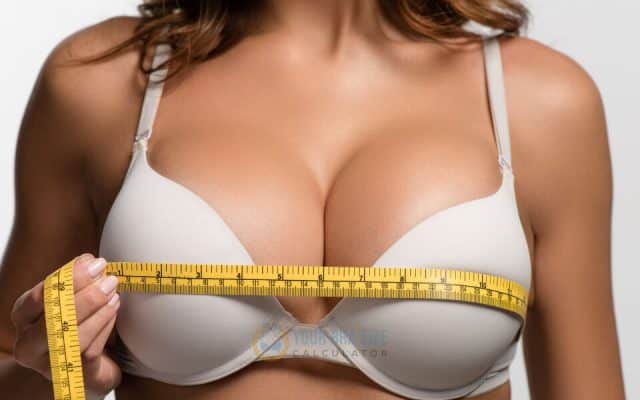
Accurate measuring for a fuller bust starts with the band, not the cup, because everything else is calculated relative to that number. Wrap a soft tape measure snugly around your ribcage, directly under your breasts, keeping the tape level all the way around and pulling it firm enough that it doesn’t slide but not so tight it digs in. Round to the nearest whole number, and if that number is odd, most sizing charts have you round up to the nearest even number for a standard starting band size.
For the bust measurement, wrap the tape around the fullest part of your breasts while wearing a well-fitting, non-padded bra, keeping the tape parallel to the floor rather than letting it dip in the back. The difference between your band and bust measurements in inches maps to a cup letter, and for larger busts that gap tends to run bigger, which is exactly why so many women in this range end up in DD, E, F, or higher cups rather than the A through C range most mainstream sizing assumes. It’s worth measuring in a couple of different bras, or bra-less with a friend’s help, since posture and existing bra fit can shift the number by half an inch or more.
Once you have both numbers, a bra size calculator converts them into a size instantly and can show you the sister sizes worth trying if your first choice doesn’t sit right. Treat that number as a starting point for trying bras on rather than a final answer, since fit varies enough between brands and styles that the same calculated size can run differently depending on cup shape and wire construction.
Why Do Straps, Bands, and Cups Fail Differently on a Fuller Bust?
Straps, bands, and cups fail for different mechanical reasons as breast volume increases, and treating all three as one problem is why so many fit attempts stall out.
In a study of 309 women across the full range of breast sizes, only about 10 percent had a bra that passed the fit check on all five components at once, and among women in the large-breast category specifically, that correct-fit rate dropped to roughly 6 percent, the lowest of any group in the study. Source: Coltman, Steele & McGhee (2018), Clothing and Textiles Research Journal
“Straps shouldn’t be doing the heavy lifting. If your shoulders ache by the afternoon, the band underneath has usually already given up.”
Strap fit runs opposite to what most people expect: it improves as breast size increases, incorrect in about 77 percent of women with small breasts but only about 41 percent of women with large breasts and 38 percent of women in the hypertrophic category, per the same research. Cup fit runs the opposite direction, becoming harder to get right as volume goes up, with cup fit failing in roughly 49 percent of small-breasted women compared to about 66 percent of hypertrophic women. Underwire and front-band fit also got significantly worse as breast size increased in the same dataset. A too-tight band pushes tissue toward the armpit and back, and a too-loose one shifts that same load straight onto the straps, which is the mechanical reason strap pain so often traces back to a band that’s one or two sizes too big rather than to the straps themselves.
What’s Causing Your Bra Problems?
Matching the symptom to the mechanical cause is faster than trial-and-error resizing, since most fit complaints point to one specific component rather than “the wrong size” in general.
| Symptom | Likely Cause | Fix to Try First |
| Straps dig into shoulders, leave marks | Band too loose, carrying too little of the load | Size down the band, size up the cup to match (sister size) |
| Spilling over the top or sides of the cup (“quad boob”) | Cup too small for breast volume | Size up the cup, keep the band the same or size down slightly |
| Gaping at the top of the cup, wrinkled fabric | Cup too large for breast shape or volume | Size down the cup, or try a different cup shape (balconette vs. full cup) |
| Underwire pokes at the sides or center, or flares outward | Wrong wire width or band size | Try a wider wire style, or resize the band |
| Band rides up in the back | Band too loose or straps overcompensating | Size down the band by one size and loosen the straps |
| Straps slip off shoulders constantly | Sloped shoulders, narrow-set straps, or band too loose | Try racerback or convertible straps, recheck band fit |
Which Bra Styles Solve Which Problem?
Different bra constructions distribute weight differently, so the “right” style depends on which fit problem you’re solving rather than which one looks best on a hanger. Full-coverage and encapsulation-style bras, which shape each breast in its own separate cup rather than compressing both into one shelf, tend to work best for fuller busts because they follow the breast’s actual shape instead of flattening it, reducing the gaping and spillage that show up when tissue gets pushed into a single molded shape it doesn’t fit.
| Style | Best For | Trade-Off |
| Full-coverage/encapsulation | Everyday wear, shape and separation, reducing spillage | Less “lift” look than push-up styles |
| Minimizer | Reducing projection under fitted tops | Can distribute tissue sideways if band is off |
| Front-closure | Limited shoulder mobility, easier one-handed wear | Fewer style options in larger sizes |
| Sports bra (encapsulation or combination) | High-impact activity, reducing bounce | Requires more precise band fit than everyday styles |
| Wireless/soft-cup | Comfort-first, post-surgical or sensitive-chest days | Less structured lift for very full busts |
A minimizing bra redistributes tissue rather than reducing it, which helps under fitted clothing but isn’t a fix for a band that’s too loose. If your main complaint is bounce or discomfort during exercise, a properly fitted sports bra matters even more for a fuller bust, since breast movement during activity is directly tied to how well the band and straps hold their position together.
Should You Try Sister Sizing Before Buying a Whole New Style?
Sister sizing is almost always worth trying before you assume you need a different brand or style entirely, since it fixes a genuine sizing mismatch without changing the construction that’s already working for you. If a bra’s cup fits your shape well but the band feels loose, try the same cup volume in a smaller band and larger cup letter (a 36D and 34DD hold roughly the same volume) before writing off the style completely. This matters most when you love how a particular bra looks or feels but one component is clearly off, since it isolates that mismatch instead of throwing out a style you’d otherwise keep buying.
| Current Size | Sister Size (Band Down) | Sister Size (Band Up) |
| 34DD | 32E/F | 36D |
| 36D | 34DD | 38C |
| 38DD | 36E/F | 40D |
| 40D | 38DD | 42C |
Cup letters aren’t standardized between brands the way band inches are, so a sister-size chart is a starting point for what to try on, not a guarantee. If you gape, spill, or slip in the same spot across several different brands, that’s a strong sign the fix is a sister size rather than a different style altogether.
What Should You Look For When Shopping Online for a Fuller Bust?
Shopping online for a larger bust size works best when you treat the size chart, the return policy, and the fabric description as three separate checks rather than one glance at the product photo. Every brand’s numbers run slightly differently even when the label says the same size, so pulling up the brand’s own chart and comparing it to your actual measurements matters more than trusting the size you wear elsewhere. A free-returns policy is close to essential here, since even careful online shopping usually means trying two or three sizes before one earns a keeper spot in your drawer.
Fabric and construction details tell you almost as much as the size chart. Wider-set, cushioned straps distribute weight more evenly across the shoulder, and a wider underwire with a higher center gore sits more securely against the ribcage on a fuller bust than the narrower wires built for smaller cup volumes. Reading the actual product description, not just the size number, for wire width and strap construction saves a return before it happens.
How Do You Choose a Bra for Sports Versus Everyday Wear?
Everyday and sports bras need to solve different problems, so a single “good bra” rarely covers both jobs well for a fuller bust. Everyday bras prioritize shape, coverage, and all-day comfort under regular clothing, while sports bras exist specifically to limit vertical and side-to-side breast movement during activity, which matters more as breast volume increases because there’s simply more mass moving with each step or jump. Encapsulation-style sports bras, which shape each breast separately the way an everyday full-coverage bra does, tend to outperform compression-only sports bras for fuller busts, since compression alone can’t fully control movement once volume passes a certain point.
Band fit matters even more during exercise than it does at a desk, because a band that shifts slightly when you’re sitting still will actively work its way up during movement. If you’re between sizes for exercise specifically, sizing down the band while keeping cup volume through a sister size usually holds better through a full workout than staying in your everyday size.
How Should You Care for Bras That Work Harder Than Most?
A bra supporting more tissue stretches and fatigues faster under normal wear, so care routine has a real effect on how long it holds its shape. Hand-washing or using a mesh laundry bag on a gentle cold cycle protects the elastic in the band, which is the component doing the most work and the first to wear out if it’s thrown in with a regular hot-water load. Skip the dryer entirely; heat breaks down the elastic fibers that keep a band snug, and air-drying flat or over a rod keeps the shape intact for far longer.
Rotating between two or three bras rather than wearing the same one daily gives the elastic time to recover its shape between wears, since fabric that’s compressed all day needs rest to bounce back the way it did when new. If you want the specifics on washing frequency, stain removal, and hook repair, a full bra care guide walks through the details beyond the basics here.
When Should You See a Professional Fitter?
A professional fitting is worth booking when you’ve tried sister sizing and a couple of different styles and something still feels off, since a trained eye can spot asymmetry, posture effects, or shape mismatches that measurements alone don’t capture. Breast tissue naturally changes with weight fluctuation, hormonal shifts, pregnancy, and age, so a size that fit perfectly two years ago isn’t a reliable guide today, and getting refitted periodically rather than assuming your size is fixed for life catches those changes before they turn into months of discomfort.
If you’re adjusting to changes after surgery, whether augmentation, reduction, or mastectomy, general comfort principles like soft fabric, front closures, and minimal seaming can help day to day, but timing, compression levels, and any wound-care specifics belong to a conversation with your surgeon or care team rather than a sizing guide. The same goes for any sudden or unexplained change in size, shape, or comfort, which is worth a conversation with a doctor rather than a new bra.
Finding What Actually Fits
Getting this right usually comes down to isolating one component at a time instead of chasing a single magic size. Start with the band, since it carries the bulk of the support work, confirm the cup holds your shape without gaping or spilling, and check that the underwire sits flat against your ribs rather than digging in or floating off your skin. Most of the discomfort blamed on “just having a large chest” turns out to be a band that’s too loose, a cup that’s a size behind where your body is, or a style that was never built to handle this much tissue in the first place, not a flaw in your body, and a sister size, a different construction, or a fresh measurement usually solves it.
Frequently Asked Questions
What bra size is considered “large” for fitting purposes?
Researchers typically classify breast volume over 700 milliliters per breast as large and over 1,200 milliliters as hypertrophic, based on 3D scanning data. Source: Coltman, Steele & McGhee (2018), Clothing and Textiles Research Journal
In everyday cup letters, that tends to land around a DD/E cup and up, though the exact letter depends heavily on band size since the same volume shows up as different letters on different bands.
Why do my straps hurt even though my cup size feels right?
Strap pain almost always traces back to the band rather than the straps themselves, since a loose band shifts weight that should sit on your ribcage onto your shoulders instead. Try tightening the band by a size or two while sizing up the cup to match through sister sizing, and the strap pressure often eases without changing anything about the straps.
How is sister sizing different from just buying a bigger bra?
Sister sizing changes the band and cup together in opposite directions to keep the same cup volume, while simply buying “a bigger bra” usually means sizing up everything at once, which can leave you swimming in fabric while the band still doesn’t grip properly. A 36D and 34DD hold roughly the same volume but distribute it very differently across the band and cup.
Do minimizer bras actually reduce breast size?
No, a minimizer redistributes breast tissue to reduce how much it projects forward under clothing, but it doesn’t change the actual volume or weight you’re carrying. It’s a styling tool for silhouette under fitted tops, not a substitute for a properly fitted everyday or sports bra.
How often should someone with a large bust get refitted?
Checking your size roughly once a year, or any time you notice a meaningful weight change, pregnancy, or shift in comfort, catches most fit drift before it becomes a daily annoyance. Breast tissue changes more than people expect over time, so a size that was correct a year or two ago is a starting point to recheck, not a guarantee.