How to Measure Your Bra Size at Home and Check That the Number Holds Up
Summarize this blog post with:


Copy the Gemini prompt manually
You measured twice, did the subtraction, and ordered the size, and now the band rides up your back while the cups gape along the top edge. Many women go through this at some point, and the cause is usually the measuring and not the math. A tape measure records two circumferences, and because each inch of difference changes the cup letter, a small slip in tension or posture can change the size you land on.
This guide covers the band and bust measurements step by step, explains why the numbers move between attempts, and shows how to test a measured size against the way a bra sits on your body. That last step matters because fit research keeps finding that measured sizes and well-fitting sizes often disagree.
Key Takeaways
- Band size comes from a snug, level measurement under your bust, and cup size comes from the gap between that number and your fullest bust measurement.
- Measure over bare skin or a thin non-padded bra, standing straight and breathing out normally.
- Take each measurement three times and use the middle reading, because factors including tension, breathing, and posture shift the number.
- Cup letters scale with the band, so the same letter holds different volumes on different band sizes.
- A tape measure gives a starting size, and a short try-on check of the band, the cups, and the center gore decides whether that size fits.
- Pregnancy, surgery, and teen development each come with their own timing, so those guides and your care team come first.
What Do You Need to Measure Your Bra Size at Home?
You need a few basic items, including a soft flexible tape measure, a mirror, and a pen and paper, and you’ll wear either a thin non-padded bra or none. A soft tape follows the curve of your ribcage and chest, while a rigid metal tape can’t wrap around your body, so a sewing tape is the better tool.
The mirror matters because it shows whether the tape runs level across your back, which is the part you can’t feel. The pen and paper keep your readings separate once you’ve taken a few. Padding and push-up shaping change the shape of your bust, which changes the reading, so a thin bra or bare skin gives a cleaner number.
If you don’t own a tape, a string that doesn’t stretch, such as cotton thread or kitchen twine, can stand in for it (see the FAQ below). Whichever tool you use, keep to one unit, either inches or centimeters, for both measurements.
How Do You Measure Your Band Size?
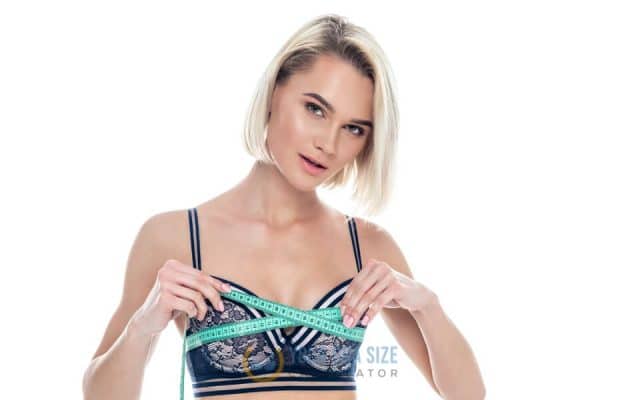
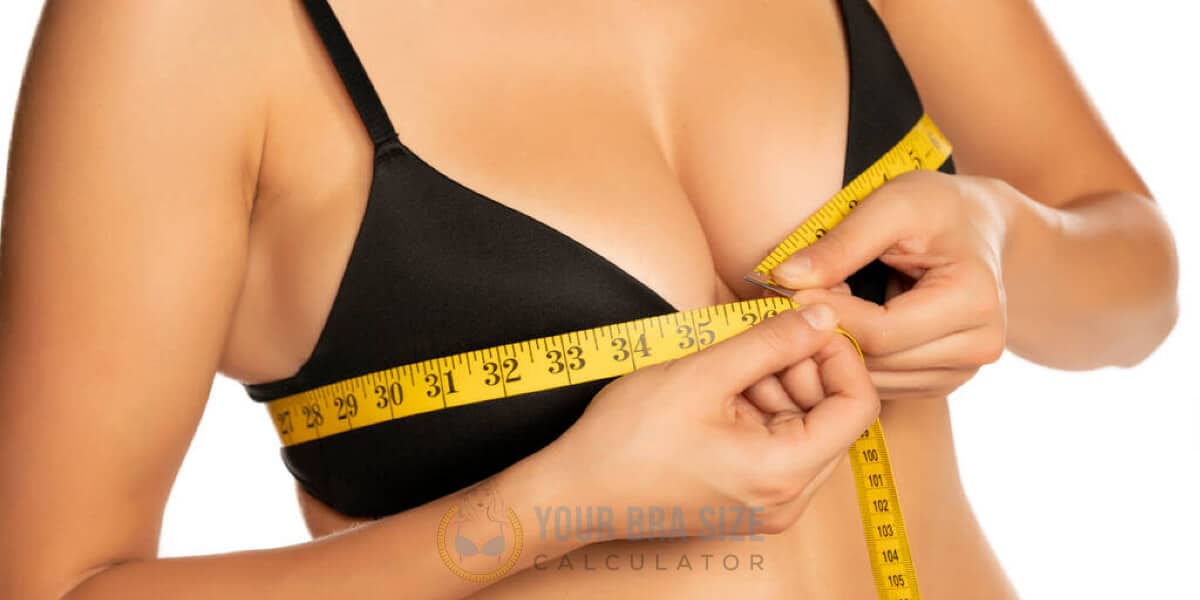
Wrap the tape around your ribcage directly under your bust, keep it level with the floor all the way around, and pull it snug enough that it doesn’t slide. A snug, level underbust measurement sets your starting band size, and you round it to the nearest whole number.
Stand upright with your arms relaxed and breathe out normally, because holding a deep breath or pulling your stomach in changes the ribcage reading. Place the tape on the ribcage just below the crease where your breast tissue meets your chest, then check the mirror to confirm it runs straight across your back and doesn’t climb toward your shoulder blades. A tape that tilts upward at the back measures a longer path than a level one, which inflates the band number. Pull until the tape feels firm against your skin without denting it, since a loose reading produces a band that’s too big.
Most US and UK brands make band sizes in even numbers, so a reading of 31 inches points toward a 30 or a 32, and you try both and keep the one that sits level and snug. European bands run in steps of five centimeters, and each brand’s chart decides how a centimeter reading maps to its label. When you shop in labels from another region, start from your own readings and the brand’s chart rather than converting one label into another, and our guide to converting bra sizes across countries covers the differences.
Underbust readings in inches and centimeters, with the even band sizes to test
| Underbust (inches) | Underbust (centimeters) | Even US/UK band size to test |
| 28 | 71.1 | 28 |
| 29 | 73.7 | 28 and 30 |
| 30 | 76.2 | 30 |
| 31 | 78.7 | 30 and 32 |
| 32 | 81.3 | 32 |
| 33 | 83.8 | 32 and 34 |
| 34 | 86.4 | 34 |
| 35 | 88.9 | 34 and 36 |
| 36 | 91.4 | 36 |
General guidance. The method is centimeters equal inches multiplied by 2.54, and an odd reading points to the even sizes on either side. Sizing varies by brand and region, so check the size chart for the brand you’re buying.
How Do You Measure Your Bust Size?
Measure around the fullest part of your bust, usually across the nipple line, with the tape level and resting lightly on your skin. This reading is looser than the band reading, because pressing the tape into breast tissue shrinks the bust number and lowers the cup letter you calculate.
Stand upright with your arms relaxed, and use the mirror to confirm the tape runs parallel to the floor across your back and doesn’t dip. Let the tape touch the surface of your breasts without squeezing, and read the number where it meets. A second reading while leaning forward from the waist lets softer or lower tissue settle forward, so record both numbers and keep both in mind when you try bras on.
If one breast is larger than the other, which is common, measure around the fuller side. A cup that holds the larger breast comfortably can be adjusted for the smaller side with a different style or a strap change, while a cup that’s too small for the larger side spills out of the top or sides.
How Do You Turn Two Measurements Into a Cup Size?
Subtract your band measurement from your bust measurement, and each inch of difference moves you up one cup letter, starting with A at one inch. As an illustrative example, a 38-inch bust and a 34-inch underbust differ by 4 inches, which points to a D cup on a 34 band.
Bra size is a two-part label made of a band number and a cup letter. The band number follows your snug underbust measurement, and the cup letter follows the difference between your bust measurement and that band measurement, so the same letter describes different cup volumes on different band sizes.
US and UK labels agree through DD and then diverge from a 6-inch difference upward, so check which system a brand uses before you read a letter off the table.
Bust minus band difference and the usual cup letter in US and UK labels
| Difference (inches) | US cup letter | UK cup letter |
| 1 | A | A |
| 2 | B | B |
| 3 | C | C |
| 4 | D | D |
| 5 | DD or E | DD |
| 6 | DDD or F | E |
| 7 | G | F |
| 8 | H | FF |
General guidance from the inch-difference method. Brands differ in how they label the larger cups, so check the brand’s own chart.
A cup letter describes a difference and not a fixed volume, which is why a D cup on a 30 band holds less than a D cup on a 38 band.
Breast volume ranged from 125 ml (Australian size 10A) to 1,900 ml (size 24DD) among 104 women, and a range of volumes corresponded to the same bra size. Source: McGhee and Steele, 2011, International Journal of Clothing Science and Technology
Sister sizing follows from the same relationship between band and cup. Moving down one band size and up one cup letter keeps the cup volume roughly similar, and our guide to calculating band and bust size shows how to use it. You can also enter your readings in our bra size calculator to see the result across several regional sizing systems, and our explainer on what the numbers and letters in a bra size mean goes deeper on the labels.
Why Does Your Measurement Change Each Time You Repeat It?
Tape tension, breathing, posture, and tape position each move the reading by small amounts, and a one-inch swing in the bust reading is enough to change the cup letter. Taking each measurement three times and using the middle value gives a steadier result than trusting a single attempt.
The common causes include a hard pull on one attempt and a light pull on the next, a held breath, slouching, and a tape that tilts at the back. Measure in front of the mirror in the same posture each time and write each reading down. If the three readings for one measurement span more than an inch, reset your stance and the tape and measure again before you calculate anything.
Calculate the size from your middle values, then calculate the sizes your highest and lowest readings would give. Those two or three sizes become your try-on list.
Readings that land within an inch of each other will keep pointing to the same two or three sizes, and those are the ones worth trying on.
How Accurate Is a Tape Measure for Finding Your Bra Size?
A tape measure gives a reasonable starting size and often misses the size that fits best. The traditional tape method overestimated band size and underestimated cup size in a 2012 study of 45 women, and it grew less accurate as band size increased, according to White and Scurr in Ergonomics.
Measurement systems did not fare better in an Australian study, where self-selection and bra-sizing measurements both produced sizes that differed from the one professional fitting criteria identified.
Eighty-five percent of 104 women in an Australian study wore ill-fitting bras, and sizes from self-selection or bra-sizing measurement systems differed significantly from the correct size (p<0.001). Source: McGhee and Steele, 2010, Journal of Science and Medicine in Sport
Judging fit by eye adds another layer of difficulty, and Haworth and colleagues tested it directly.
All 24 participants failed an objective bra fit assessment, with 77 fit issues identified, and their self-reported fit matched the assessment in only 51% of instances. Source: Haworth et al., 2025, International Journal of Fashion Design, Technology and Education
Each of these studies recommends teaching women the criteria professional fitters use to judge fit, and White and Scurr add that less emphasis belongs on the measured number itself. The tape measure still earns its place, because it narrows a wide range of sizes to two or three worth trying, and the checks in the next section decide between them.
How Do You Check That a Measured Size Fits?
Put the bra on, fasten it on the loosest hook, and check four things, including whether the band sits level around your back, whether the cups contain your tissue smoothly, whether the center gore lies flat against your breastbone, and whether the straps stay in place without carrying most of the load. These checks follow the general approach of the fit criteria that professional fitters and fit researchers use, and they decide between the two or three sizes your readings produced.
Start with the band, because a band that rides up your back is usually too large and pushes the work onto the straps. The usual move is then a sister size with a smaller band and a larger cup, or the reverse if the band feels tight enough to leave deep marks.
What you notice when you try a bra on, and what to try next
| What you notice | What it often means | What to try next |
| Band rides up your back or feels loose on the tightest hook | Band too large | Smaller band with a larger cup (sister size) |
| Band feels tight or leaves deep marks | Band too small | Larger band with a smaller cup (sister size) |
| Tissue spills over the top or sides of the cups | Cup too small | Next cup letter up on the same band |
| Fabric wrinkles or gapes at the top of the cups | Cup too large, or a shape mismatch | Next cup letter down, or a different cup style |
| Center gore floats away from your breastbone | Cups too small, or a shape mismatch | Next cup letter up, or a different style |
| Straps dig in while the band rides up | Band isn’t carrying its share of the support | Fix the band first, then re-check the straps |
General guidance. Sizing varies by brand and region, and a fit that stays uncomfortable is a reason to talk to a certified fitter.
Change one thing at a time so you can see which change helped. Our guide to telling whether your bra fits correctly walks through each check in more detail.
What Changes for Larger Cups, Pregnancy, Teens, or After Surgery?
The measuring steps stay the same in each of these situations, though the numbers can move faster or call for more try-ons. Larger bands tend to be harder to size by tape, pregnancy and development keep changing your readings, and surgery adds timing questions that belong to your care team.
The 2012 Portsmouth study found the tape method became less accurate as band size increased, so if your readings land toward the upper end of the chart, plan to try more neighboring sizes. Our guide to bra fitting for large breasts covers styles and fit checks for fuller cups.
During pregnancy your ribcage and bust both change over the months, so a reading from early on can be out of date later. Our guide to measuring bra size when pregnant covers how to measure as your body changes.
Teen bodies change on their own schedule, and there isn’t one correct age or size for a first bra. Our guide to measuring bra size for teenagers walks through the same steps in a teen-friendly way.
After breast surgery, timing, compression, and which garment to wear belong to your surgeon or care team, so ask them before you measure or buy. Once you’re cleared, the same steps apply, and a certified fitter can help while your shape settles.
Is Measuring at Home Enough to Find a Bra That Fits?
Measuring at home is enough to get a workable starting size, and the try-on checks turn that starting size into one that fits. A professional fitting adds a second set of eyes, though it isn’t a guarantee either: 67% of 24 women with D+ cups still failed a fit assessment in a professionally fitted bra, according to Haworth and colleagues in Applied Ergonomics (2022).
Write down your three readings, the sizes you tried, and which one passed the checks. That note shows how a brand’s sizing runs on you, and it gives you a starting range when your bras begin to feel different.
Frequently Asked Questions
Should you measure your bra size with a bra on or off?
Either works if the bra is thin and non-padded. Padded and push-up styles change the shape of your bust and distort the bust reading, so avoid them for this step.
Do you measure bra size in inches or centimeters?
Use whichever unit your tape shows more clearly, and keep it the same for both measurements. US and UK labels use inches and EU labels use centimeters in steps of five, so check the brand’s chart when its unit differs from your readings. One inch equals 2.54 centimeters.
Can you measure your bra size at home without a measuring tape?
Yes, with a string or ribbon that doesn’t stretch. Wrap it where the tape would go, mark where it meets itself, and read the length against a ruler. String is harder to keep level, so repeat each reading and expect to try the neighboring sizes.
How do you measure bra size at home if your breast tissue sits lower or feels softer?
Stand upright and measure the fullest part of your bust wherever your tissue sits, with the tape level across your back. A second reading while leaning forward from the waist shows how much your measurement varies, so keep both numbers. Then try the sizes on, since the fit checks matter more than the tape here.
Do you round up or down when measuring band size?
Round to the nearest whole number first. Most US and UK brands make even band sizes, so an odd reading means trying the even size on either side, such as a 30 and a 32 for a reading of 31 inches. Keep the one that sits level and snug on the loosest hook.