How to Calculate Your Band and Bust Size (and Actually Trust the Number)
Two measurements and a bit of subtraction are all it takes to get from “I have no idea what size I am” to a real starting point. The band number tells you how much support you’re getting around your ribcage. The gap between your band and bust tells you the cup. Everything else, the sister sizing, the brand quirks, the little adjustments, builds on those two numbers. Most of the frustration people feel with bra shopping traces back to skipping this step or measuring it loosely. Get the band snug and the bust honest, and the bra size calculator does the rest of the math for you.
Key Takeaways
- Band size comes from your underbust measurement, rounded to a whole number.
- Cup size comes from the difference between your bust and band measurements, not from bust size alone.
- A snug, level band does most of the actual support work; the cup should just contain your tissue without gaping or spilling.
- Cup letters aren’t fixed sizes. A D cup on a 30 band holds far less volume than a D cup on a 38 band.
- Sister sizes let you shift the band up or down a size while keeping roughly the same cup volume.
- Treat any calculator result as a starting point, since fit still varies by brand, wire shape, and fabric.
What Do Band Size and Bust Size Actually Measure?
Band size measures the firm circumference of your ribcage directly under your breasts, and bust size measures the loose circumference around the fullest part of your chest. Together, those two numbers are the entire input the calculator needs. Everything downstream, the letter, the number, the sister-size options, gets derived from this pair rather than from either measurement alone.
Band size is the snug, level measurement around your ribcage just beneath your breasts, taken firmly enough that the tape doesn’t slide but loosely enough that you can still breathe normally. Bust size is the loose measurement around the fullest part of your chest, usually at nipple level, taken without compressing any tissue.
The band carries most of the actual support, roughly 80 percent of it by most fitting guides, which is why getting that number snug matters more than most people expect. A loose band forces the straps to pick up the slack, which is exactly what causes shoulder grooving and that all-day tugging feeling.
How Do You Measure Your Band Size Correctly?
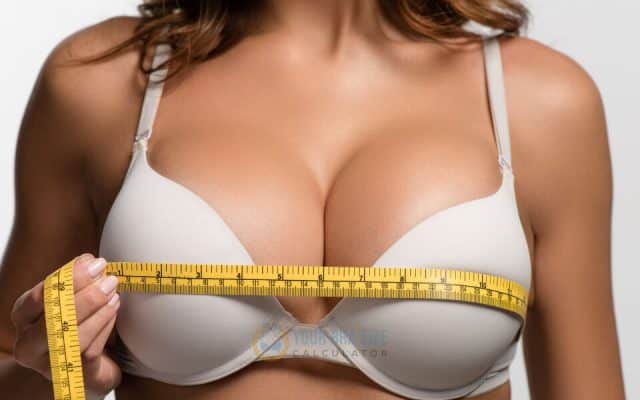
Wrap a soft measuring tape directly under your bust, keeping it level and parallel to the floor all the way around your back. This measurement becomes your starting band size once you round it to a whole number, and it should feel snug without digging in.
- Wear a non-padded bra, or measure without one, so the number reflects your actual ribcage.
- Keep the tape level across your back. It’s common for the tape to ride up in the back and throw off the reading.
- Round to the nearest whole number, then round odd numbers up to the next even number for US and UK sizing (a 31″ reading becomes a 32 band).
- Exhale normally rather than sucking in. A held breath compresses your ribcage and shrinks the number artificially.
If the number changes noticeably depending on how firmly you pull the tape, that’s worth noting. It usually means the band you’re currently wearing has stretched out, or that you’ll want to double-check the reading a second time before committing to it.
How Do You Measure Your Bust Size for the Cup Calculation?
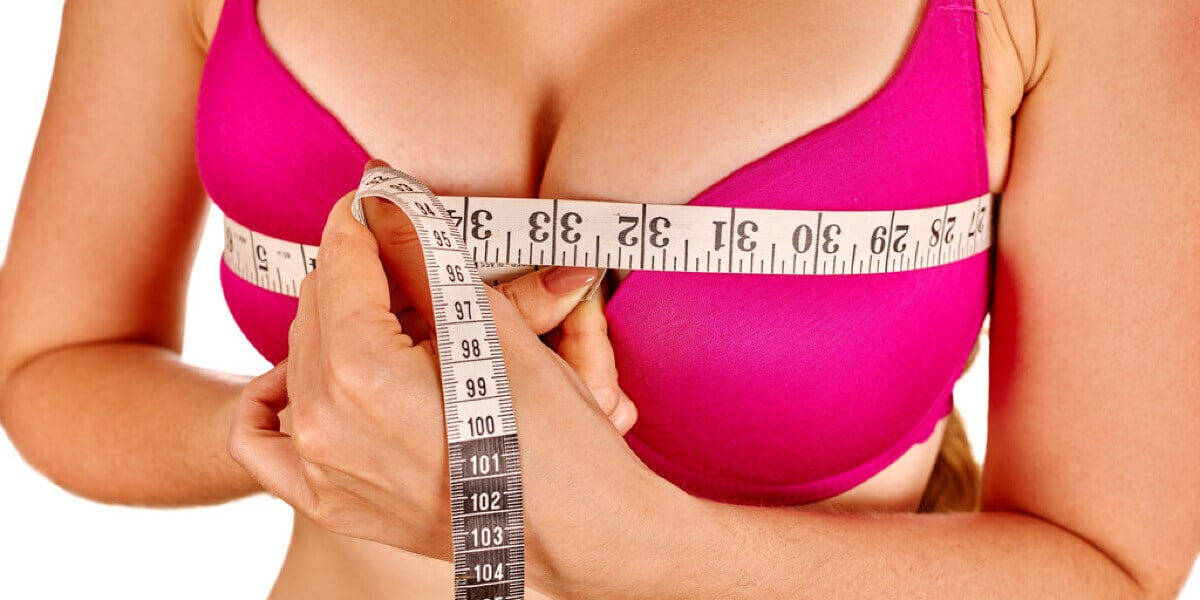
Measure loosely around the fullest part of your bust, typically at nipple level, while standing straight with your arms relaxed at your sides. This is the second number the calculator needs, and unlike the band, it should stay loose rather than snug.
The most common measuring mistake is compressing tissue with the tape, which shrinks the reading and pulls the calculated cup size down with it. The tape should sit against your body without flattening anything, following the natural curve of your chest rather than cutting a straight line across it.
“Take the bust measurement over the fullest part of your chest, arms relaxed at your sides, without letting the tape squeeze.” That’s the single instruction fitting guides repeat most consistently, because it’s also the step people rush.
How Does the Difference Between Bust and Band Become a Cup Letter?
Subtract your band measurement from your bust measurement, and each inch of difference maps to one cup letter, starting at A for a one-inch difference. This is the entire cup-size formula: no separate breast measurement, no guessing, just the gap between two numbers you already have.
| Bust minus Band | Cup Letter |
| Less than 1″ | AA |
| 1″ | A |
| 2″ | B |
| 3″ | C |
| 4″ | D |
| 5″ | DD / E |
| 6″ | DDD / F |
| 7″ | G |
| 8″ | H |
This is also why cup letters are relative rather than fixed. A D cup on a 30 band and a D cup on a 38 band share the same letter but not remotely the same volume, as confirmed by a 1999 peer-reviewed note in Plastic and Reconstructive Surgery, since the cup’s actual size scales with the band it’s attached to. A wider band spreads the same difference across a larger circumference, so the cup has to hold proportionally more to produce the same letter.
What Small Mistakes Throw Off an Accurate Result?
The two most common errors are a loose band measurement and a compressed bust measurement, and both push the calculated size in the wrong direction at once. A loose band inflates the band number and shrinks the bust-minus-band gap, which can knock you down a full cup size or more from where you actually belong.
- Measure over a non-padded bra or bare skin, never over a push-up or heavily lined bra.
- Have a friend check that the tape sits level across your back for both measurements.
- Remeasure if you’ve had a recent shift in weight, pregnancy, or breastfeeding, since both numbers can move independently.
- Treat the result as a starting size and expect to try a sister size if the band or cup feels slightly off.
By the numbers: A small 2008 study of 30 university-aged women published in Chiropractic & Osteopathy found that 80 percent were wearing an incorrectly sized bra, with 70 percent in a band or cup that ran too small. The sample was small, but the pattern (undersizing rather than oversizing) shows up consistently across similar fitting research.
What Is Sister Sizing, and When Do You Need It?
Sister sizing means moving one band size in one direction while moving one cup letter in the opposite direction to land on roughly the same cup volume. If your calculated size feels close but not quite right, a sister size is almost always the next thing to try before assuming the calculator got it wrong.
Say your result comes out to 34C. If the band feels a little loose but the cups fit well, 32D is your sister size: smaller band, one cup letter up, same approximate volume. If the band feels snug but the cups gape slightly, 36B moves the other direction. This connects directly to why cup letters and band size can’t be read in isolation, since the same volume of tissue produces a different letter depending on the band it’s paired with.
Does Your Size Change Between Brands or Countries?
Your measurements stay the same, but the size label attached to them can shift by brand and by region, since manufacturers don’t all cut to identical patterns. This is normal and doesn’t mean your measuring was wrong; it means you may need to check a specific brand’s chart against your measured band and bust numbers before ordering.
If you’re shopping sizes labeled for a different region, it helps to start from your raw underbust and bust numbers rather than converting a US or UK label directly, since rounding differences compound across conversions. Our India calculator and Japan, Korea, and China calculator apply the sizing conventions used in those markets directly to your measurements, and our guide on converting bra sizes across international brands walks through the label differences in more depth.
“Your result gives you the best measurement-based starting point, then you can adjust using fit checks, sister sizes, and brand size charts.” A calculator result is a launchpad, not a verdict.
How Do You Know the Calculated Size Actually Fits?
A well-fitted bra keeps the band level and parallel to the floor, keeps the cups smooth without gaping or spillage, and keeps the center gore lying flat against your breastbone. Try the calculated size on and run through those three checks before deciding you need a different number.
- Band: sits level all the way around, doesn’t ride up in back, and stays snug on the loosest hook.
- Cups: fully contain your tissue with no spilling over the top or sides and no empty puckered fabric.
- Center gore: rests flat against your breastbone rather than floating away from your body.
- Straps: stay in place without digging in once the band is doing its share of the support.
If the band checks out but the cups gape or spill, that’s a cue to try a sister size before assuming your measurements were off. Our guide on telling whether your bra actually fits walks through each of these checks in more detail, and our piece on handling gaping, spillage, and slipping straps covers what to adjust once you’ve narrowed down the issue.
What If Your Band Feels Too Loose After You’ve Bought It?
Bra bands stretch out with wear and washing well before the rest of the garment shows signs of aging, which is a normal reason your measured size might feel different from a bra you already own. If your current bras all feel loose in the band despite matching your calculated size, the bras themselves are likely the ones that have changed.
Moving to the next hook in from the loosest one is the first fix, and it’s built into every bra for exactly this reason. Once you’re on the tightest hook and it’s still loose, that’s the signal to remeasure rather than to keep adjusting the same bra. Our guide on making a bra band tighter without sewing covers options beyond the hook-and-eye adjustment.
Trust the Measurements, Then Trust the Fit Check
Once you’ve got an honest band measurement and a relaxed bust measurement, the math genuinely is that simple: round the band, subtract for the cup, and let the calculator hand you a starting size. The rest is just confirming it on your body, and adjusting with a sister size if something feels slightly off. That’s not a failure of the calculator, it’s exactly how bra fitting is supposed to work.
Ready to get your own numbers? Head to the bra size calculator and plug in your band and bust measurements, or read through our guide on measuring your bra size accurately at home for a slower, step-by-step walkthrough before you pick up the tape measure.
Frequently Asked Questions
How often should I remeasure my band and bust size?
Remeasuring roughly every six months is a reasonable default, and sooner if you’ve had a noticeable weight change, started or finished breastfeeding, or simply noticed your current bras fitting differently. Both band and bust measurements can shift independently, so it’s worth taking both again rather than assuming only one changed.
Why does my calculated size feel different from what I usually buy?
This usually comes down to a stretched-out band on your current bras, inconsistent measuring, or genuine brand-to-brand variation in cut. Try the calculated size and a sister size or two before assuming the calculator missed, since a close-but-not-perfect result is normal and expected.
Can I measure accurately without help from another person?
Yes, most people measure themselves successfully with a mirror to check that the tape stays level. Having a friend confirm the back of the tape hasn’t ridden up does improve accuracy, but it isn’t required if you check your reflection carefully at both the band and bust steps.
Does the calculator give different cup letters for US and UK sizing?
Our calculator maps the same bust-minus-band difference to the same cup letter across US, UK, and Canadian sizing, since the letter progression itself doesn’t diverge between these systems the way band-size labeling sometimes does. Where regional sizing genuinely differs, such as EU, French, or Asian markets, use the dedicated regional calculator so the conversion matches local conventions.
What should I do if my band and cup measurements land between two sizes?
Round the band measurement up to the next even number as usual, then try both the calculated cup and the cup one letter down with the next band size up as a sister-size comparison. Whichever one leaves the band level and the cups smooth without gaping is the better everyday fit.