Can You Go Braless After Breast Augmentation Surgery?
The first week after augmentation, the real question usually isn’t about fashion. It’s about relief, and about when your chest can stop feeling wrapped in someone else’s clothes. “Going braless” and “not wearing a bra” turn out to be two different questions, and the gap between them matters more than most recovery guides let on.
What you put against healing tissue in week one has almost nothing to do with what you’ll wear in month three. The construction reasoning behind each stage, front closures, wire-free cups, band tension, is worth understanding before you reach for anything with a wire in it.
Key Takeaways
- Going braless isn’t one decision, it’s a staged path from compression garment to soft wire-free support to your regular bra.
- Underwire is the last piece to come back, not the first. Most surgeons hold off on rigid wire for weeks to months.
- Swelling makes early sizing a moving target. A band that fits comfortably at ten days can feel loose by week four.
- A few unsupported minutes, like a shower, is a different question from going without support for a full day or overnight.
- Your surgeon’s specific timeline always overrides general guidance here. Incision placement, implant position, and your own healing pace all shift the calendar.
What Bra Should You Wear Right After Breast Augmentation?
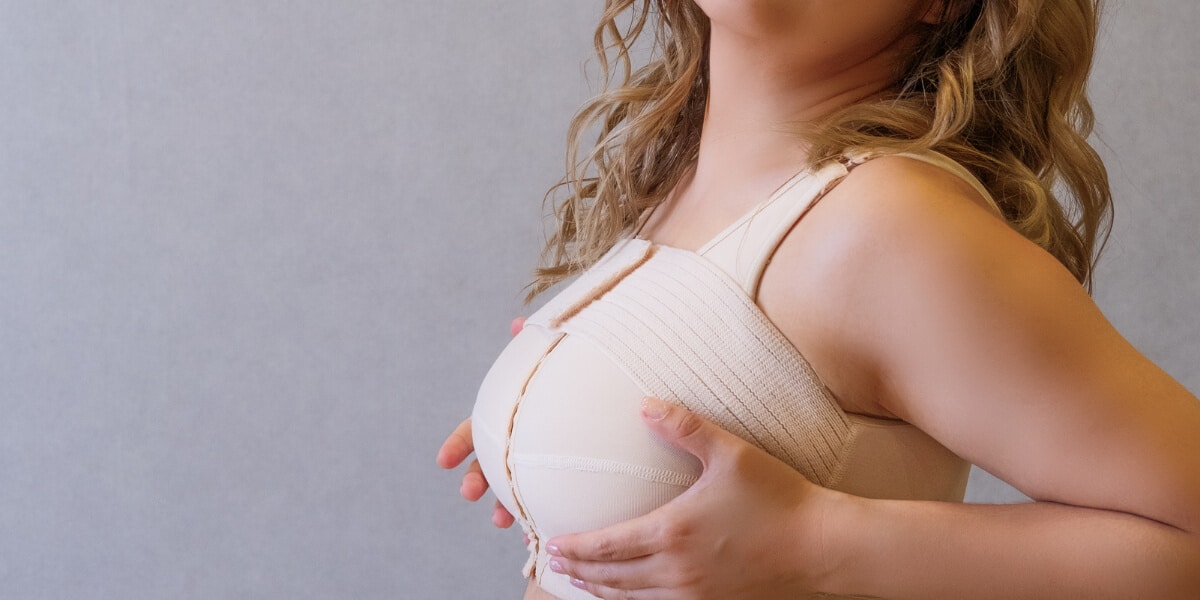
In the first days after surgery, the bra you wear is chosen for wound protection and swelling control, not for shape or style. Most surgeons send patients home in a front-closure surgical or compression bra, and that construction choice is deliberate: a front closure means you never have to reach behind your back or lift your arms overhead to get dressed, both of which strain fresh incisions.
These garments skip underwire entirely. A rigid wire needs a stable, settled breast shape to sit against without digging in, and that stability simply doesn’t exist yet. Instead, compression and surgical bras rely on a wide, soft band and a molded or seamless cup to distribute gentle, even pressure across the whole chest rather than concentrating it at a single point the way underwire does.
What Type of Bra Works Best at Each Recovery Stage?
Bra construction should change as healing progresses, moving from rigid support toward your normal wardrobe in stages rather than all at once. The table below maps common stages to garment type and the fit reasoning behind each, but treat the timing column as a general reference, not a personal prescription; your surgeon’s specific instructions always come first.
| Recovery Stage | Typical Garment | Why This Construction |
| Early days | Front-closure surgical or compression bra, no wire | Wide soft band spreads pressure evenly; front closure avoids overhead arm movement |
| Early weeks | Wire-free sports bra, seamless molded cup | Gentle, consistent compression without a rigid edge pressing on healing tissue |
| Mid recovery | Wire-free everyday bra, wider band, adjustable straps | Tissue and swelling are more settled but still shifting; flexible band gives room to adjust |
| Later recovery | Regular bra, underwire only once cleared | Shape has stabilized enough for a rigid wire to sit against without pressure points |
Underwire is the last piece of the wardrobe to come back after augmentation, not the first.
Can You Go Braless for Short Periods After Breast Augmentation?
A few unsupported minutes, like the time it takes to shower or change clothes, is a fundamentally different question from going without support for hours at a stretch. Brief, occasional lack of support doesn’t carry the same cumulative load on healing tissue that a full day or a night of movement does, which is why most post-op instructions distinguish between the two rather than banning bralessness outright.
The reasoning comes down to load over time. Unsupported breast tissue experiences gravity and movement continuously while you’re upright and active; a few minutes barely registers, but stacking that up across a whole day changes the picture. This is also why so many practices ask patients to keep some form of support on around the clock in the earliest weeks rather than just during the day.
| Situation | General Guidance | Why |
| Shower or quick change | Usually fine at any stage post-swelling, per your surgeon’s clearance | Minimal duration means minimal cumulative load on tissue |
| Sleeping overnight | Most surgeons ask for a soft wire-free bra through early recovery | Hours of rolling and repositioning without support add up |
| A full day at home | Wire-free support still recommended until your surgeon clears otherwise | Continuous gravity and movement over many hours |
| Exercise or brisk activity | Supportive wire-free sports bra recommended well past initial healing | Higher-impact movement multiplies the load on unsupported tissue |
When Can You Sleep Without a Bra After Breast Augmentation?
Most surgeons ask patients to sleep in a soft, wire-free bra for at least the first several weeks, because overnight movement, rolling, stretching, shifting position, happens without any conscious control over it. A bra you’d never notice during the day can matter a great deal at 3 a.m. when your body is doing all the moving for you.
The exact week you’re cleared to sleep braless depends on how your individual healing is progressing, so this is one of the few timing questions in the whole recovery process that genuinely can’t be generalized with a specific number. What can be said in general is that the shift usually happens gradually: full-time compression, then wire-free support around the clock, then wire-free support at night only, then nothing at all. Ask your surgeon where you currently sit on that sequence rather than working from a fixed date.
How Do You Size a Bra When Swelling Keeps Changing Your Measurements?
Size a transitional bra by band tension and comfort rather than by a single measurement, because swelling makes any one number unreliable for weeks at a time. A band that closes on the loosest hook today may need to move up a hook or two within days as swelling shifts, and that’s normal rather than a sign you measured wrong the first time.
Size a transitional bra by band comfort and how it feels today, not by a measurement you took before surgery.
This is the part of augmentation recovery that gets the least useful advice, because it isn’t really a sizing problem so much as a moving-target problem. Cup volume and band tension settle at different speeds: the band tends to stabilize faster than final breast shape does, since shape depends on both swelling resolution and the tissue settling around the implant over a longer stretch of time. Buying one wire-free bra in your pre-surgery band size and one a size up, both with stretchy, adjustable bands, covers most of that window without repeated purchases. Once swelling has mostly resolved, running your updated measurements through a band and bust size calculator will give you a clearer read than guessing from how last year’s bras used to fit. If you’d rather skip straight to numbers, the site’s bra size calculator does the band and cup math for you once you have fresh measurements in hand.
Swelling doesn’t care what your tape measure said last week, and neither should your bra shopping.
What Actually Counts as a “Post-Surgical Bra”?
A post-surgical bra is any garment built around three specific construction choices: a front closure so you never raise your arms overhead to put it on, a completely wire-free cup so no rigid edge presses on healing tissue, and an adjustable, non-restrictive band wide enough to distribute pressure evenly instead of concentrating it in one place.
Post-surgical bra: a front-closure, wire-free garment with an adjustable band, designed to support healing breast tissue without concentrating pressure at any single point.
What About Sports Bras and Underwire During Recovery?
A well-built sports bra earns its place earlier in recovery than a regular bra does, because compression-style sports bras are already built the way post-surgical support needs to be: wire-free, wide-banded, and designed to hold tissue still against movement rather than shape it into a particular silhouette.
Underwire works on a completely different principle. It relies on a fixed underbust curve to sit against, flaring outward at the sides to frame breast tissue rather than compress it, and that flare needs settled, stable anatomy underneath it to sit flat instead of digging in. That’s precisely what early recovery doesn’t have yet, which is why wire-free construction isn’t a downgrade during this stretch, it’s the more appropriate tool for the job until your surgeon confirms your shape has settled enough for wire to sit comfortably again.
How Common Is Breast Augmentation, and Who’s Having It Done?
Breast augmentation remained one of the most frequently performed cosmetic surgical procedures in the United States in 2024, with 306,196 implant placement procedures reported by the American Society of Plastic Surgeons, a 1 percent increase over 2023.
306,196 breast augmentation procedures were performed in 2024, up 1% from 2023. Source: American Society of Plastic Surgeons, 2024 Procedural Statistics Release
Patients in their 30s made up the largest single share of augmentation patients, representing 37 percent of all breast augmentation procedures in 2024, according to ASPS data, many of them navigating recovery alongside the same life-stage fit questions that come with pregnancy, breastfeeding, and postpartum changes.
37% of 2024 breast augmentation patients were in their 30s, the largest age share of any decade. Source: American Society of Plastic Surgeons
Does Going Braless Too Early Affect Your Results?
Unsupported movement during healing can pull against tissue that hasn’t finished settling into position, which is the core reason most surgeons ask for consistent support in the early weeks rather than leaving it optional. Gravity and repeated motion work on soft tissue the same way regardless of whether that tissue has recently been surgically altered; the difference is that newly healing tissue has less structural resilience to work with while it stabilizes.
None of this means you need to panic about a single unsupported stretch or a bra that slipped off overnight. It’s the sustained pattern that matters, not one isolated moment, and your surgeon is the right person to flag any specific concern about swelling, shape, or discomfort that feels different from what they described as normal.
Related Reading for Your Recovery
If you’re navigating bras across a broader medical timeline, wearing a bra during surgery itself covers what happens before you ever reach the recovery stage, and post-mastectomy bra fitting walks through a related but distinct set of post-surgical fit questions for anyone navigating a different kind of breast surgery.
Once you’re back in your everyday wardrobe, learning to tell whether a bra actually fits and understanding how strap style affects support both help you avoid relearning fit from scratch after months in recovery-specific garments.
The Bottom Line
Going braless after breast augmentation isn’t a single yes-or-no decision, it’s a sequence: full support, then wire-free support around the clock, then wire-free support part-time, then your normal wardrobe once your surgeon confirms your shape has settled. Each stage exists for a specific, understandable reason rooted in how healing tissue responds to pressure and movement, not as an arbitrary rule to wait out.
Trust the sequence, keep your surgeon in the loop about anything that feels off, and let your bra shopping follow your healing rather than a calendar you found online. The wire-free bra you reach for in week two isn’t a compromise, it’s exactly the right tool for where your body is right now.
Frequently Asked Questions
When can I sleep without a bra after breast augmentation?
Most surgeons ask patients to sleep in a soft, wire-free bra for at least the first several weeks, since overnight movement happens without any control over it. The exact timing depends on your individual healing, so confirm your specific stage with your surgeon rather than working from a fixed number of weeks.
Can I go braless for a few hours after breast augmentation?
Brief unsupported stretches, like a shower or getting dressed, carry a very different load than hours of movement without support. Many patients can manage short periods earlier than they can go without support for a full day, but your surgeon’s specific clearance should guide the timeline.
What bra should I wear before I can go braless again?
Start with a front-closure surgical or compression bra in the earliest days, then move to a wire-free sports bra as swelling reduces, and finally a wire-free everyday bra before returning to your regular wardrobe. Underwire is always the last piece to come back, once your surgeon confirms your shape has settled enough for it.
How tight should a compression or sports bra be after breast augmentation?
It should feel snug and supportive without cutting into skin, restricting breathing, or leaving deep marks that don’t fade quickly after you take it off. Compression level and duration are specific to your procedure and healing, so follow your surgeon’s instructions rather than a general tightness guideline.
When can I wear an underwire bra again after breast augmentation?
Underwire generally comes back later than any other bra style, since it relies on a stable, settled shape to sit against without pressing into healing tissue. Most surgeons want to see that your shape has stabilized before clearing wire, so this is a question to bring directly to your follow-up appointments.