Should I Wear a Bra During Pregnancy?
Somewhere around week six or seven, your bra stops fitting the way it used to. The band feels snugger by evening, the underwire presses somewhere it never used to, and you catch yourself wondering whether the smart move is to just stop wearing one altogether.
You don’t have to choose between comfort and support. Pregnancy changes breast tissue faster than almost any other stage of life, and the right bra can actually make that change easier to live with rather than something to tolerate. The wrong one just adds friction to a body that’s already working overtime.
Here’s what actually helps: how your chest changes trimester by trimester, whether underwire is really off the table, and how to tell when it’s time to size up instead of just loosening a hook.
Key Takeaways
- Wearing a bra during pregnancy is safe. There’s no medical reason to avoid one, and for most women it reduces discomfort rather than causing it.
- Breast tissue grows fastest in the first and third trimesters, so expect at least one, often two, band and cup size changes before delivery.
- Underwire isn’t automatically off-limits, but a bra that leaves red marks or digs into swollen tissue should be replaced regardless of wire.
- Wide, adjustable straps and a soft, stretch band matter more than any specific brand or style during this stage.
- Skipping a bra entirely is a personal comfort choice, not a safety issue, though most women find some support reduces back and shoulder strain.
- There’s no evidence that wearing a bra now affects your milk supply later.
Is It Safe to Wear a Bra During Pregnancy?
Yes. Wearing a bra during pregnancy is safe for you and your baby, and there is no scientific evidence linking it to any pregnancy complication. The confusion usually comes from the same handful of myths that circulate around maternity wear, most of which have no basis in anatomy.
A bra sits entirely outside the abdominal cavity, so it has no physical contact with the uterus, the amniotic sac, or the baby. What it does interact with is your rib cage and breast tissue, both of which change shape substantially during these nine months. If you’re also weighing whether to keep a bra on overnight, our guide to wearing a bra to bed while breastfeeding covers the postpartum side of that question.
The real question isn’t whether you can wear a bra during pregnancy. It’s whether your current bras still fit a body that’s actively changing shape, and for most women, the honest answer by the second trimester is no.
Why Do Your Breasts Change So Much During Pregnancy?
Your breasts grow because rising estrogen and progesterone increase blood flow and stimulate the glandular tissue that will eventually produce milk. That growth is not subtle. Underbust circumference expands as the rib cage flares to accommodate a growing uterus, and cup volume increases as milk ducts and fatty tissue develop, which is why both numbers on your bra size tend to move, not just one.
Breast volume increased by an average of 27.2% between the first and third trimesters in a 2026 study of 83 pregnant women. Source: Tutkuviene et al., Scientific Reports, 2026
That same study found something worth knowing if you’re a smaller-chested woman expecting a modest change: growth was actually largest, proportionally, in women who started pregnancy with smaller breasts, not larger ones. Nobody’s exempt from needing a fit check as the months go on.
Almost a third of women shifted into a different breast-size category (small, medium, or large) between early and late pregnancy. Source: Tutkuviene et al., Scientific Reports, 2026
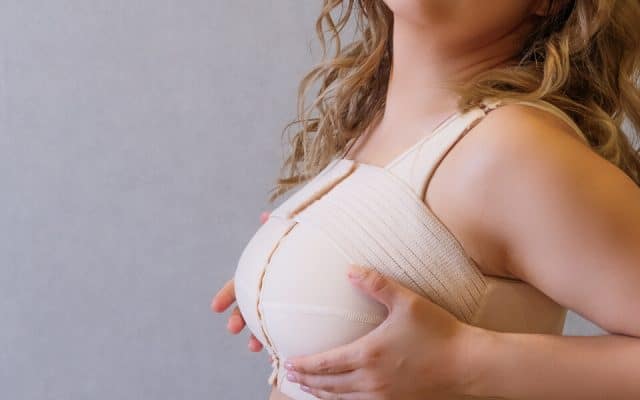
Maternity bra: a bra built with a wider, more stretchable band and deeper, more adjustable cups than a standard bra, designed to accommodate the rib cage expansion and breast growth of pregnancy. It’s a distinct category from a nursing bra, which adds a drop-down or clip-away cup for feeding access after birth. Some bras combine both features.
What Should You Look for in a Pregnancy Bra?
The band matters more than most women expect. A too-tight band pushes tissue toward the armpit and back, which is where a lot of pregnancy bra discomfort actually originates, not the cups. Look for a band with several rows of hooks so you have room to loosen it as your rib cage expands, and stretch panels that move with you between fittings rather than requiring a whole new bra every few weeks.
Wide, cushioned straps distribute weight across your shoulders instead of concentrating it into two thin lines, which becomes more noticeable as cup size increases and breast tissue gets heavier. If you’re not sure your current straps are doing their job, the pattern to watch for is simple: red grooves at the end of the day mean the strap is too narrow or the band is doing too little of the work.
Soft, breathable fabric like cotton or a cotton-modal blend also matters more now than it might have before, since pregnancy increases blood flow to the skin and makes many women more sensitive to synthetic fabrics and seams. If your current straps are the wrong style for a growing chest, our guide to bra strap types breaks down which designs distribute weight best.
“A bra that fit perfectly in week eight has no obligation to still fit in week twenty. Treat every trimester as a reason to check, not just a reason to loosen a hook.”
Is Underwire Safe During Pregnancy?
Underwire itself does not harm you or your baby. There’s no clinical evidence that a properly fitted underwire bra affects breast tissue, milk ducts, or circulation in any meaningful way. The concern with underwire during pregnancy is entirely about fit, not the wire itself: as breast tissue grows and shifts, a wire that used to sit flush against your ribcage can start digging into soft, sensitive tissue instead, which is uncomfortable regardless of pregnancy.
Many women naturally gravitate toward wire-free styles by the second trimester simply because soft bands and molded cups are more forgiving of a body that’s still changing shape. That’s a comfort preference, not a safety requirement.
| Feature | Underwire | Wire-Free |
| Support for larger cup sizes | Stronger structural lift | Relies on band and fabric tension |
| Comfort as tissue swells | Can dig in if sizing lags behind growth | Flexes with changing shape |
| Best trimester fit | First trimester, if properly sized | Second and third trimester |
| Refitting frequency needed | Higher, wire position is fixed | Lower, more forgiving of small changes |
If you’re between sizes or unsure which band and cup combination fits your current chest, running your measurements through the bra size calculator is faster than guessing from a size chart, and it’s worth repeating that check every few weeks as pregnancy progresses.
How Much Does Bra Size Change Trimester by Trimester?
Growth doesn’t happen on a fixed schedule, but most women notice a recognizable pattern: an early jump in tenderness and cup volume, a plateau in the middle months, and a second growth spurt near the end as the body prepares for milk production.
| Trimester | Typical Change | What to Prioritize |
| First (weeks 1-13) | Tenderness and a partial cup size increase, often before the bump shows | A soft, unpadded bra with a little extra stretch in the band |
| Second (weeks 14-27) | Band size increases as the rib cage expands; cup growth can slow | A dedicated maternity bra with multiple hook rows |
| Third (weeks 28-40) | A second cup size jump is common as milk-producing tissue develops | A nursing-capable bra sized with room to spare, not sized tight |
If you’re planning ahead for after delivery, measuring for a nursing bra during pregnancy and our guide to bra fitting for nursing mothers walk through what changes again once your milk comes in.
Should You Wear a Bra to Sleep During Pregnancy?
That’s entirely your call. Some women find a soft, wire-free sleep bra reduces tenderness and keeps heavier breasts from shifting uncomfortably overnight, especially in the third trimester. Others find any fabric touching sensitive skin at night is more irritating than helpful. Neither choice carries any risk.
If you do choose to sleep in one, skip anything with underwire or a firm band, since you want zero pressure points during hours you can’t adjust for. Our full breakdown of bras and bedtime during breastfeeding covers what changes once you’re feeding a newborn, which is a slightly different calculation than pregnancy alone.
Does Skipping a Bra Cause Sagging or Back Pain?
There’s no controlled research proving that going braless during pregnancy causes long-term sagging. Breast shape after pregnancy is driven mainly by genetics, skin elasticity, and the total amount of tissue growth and shrinkage over the course of pregnancy and breastfeeding, not by whether a bra was worn in between. What’s better established is the connection between breast size and physical strain: heavier, unsupported breast tissue places more load on the back and shoulders, and that load only grows as pregnancy progresses.
Back pain was reported by just 4.9% of women with a B-cup, compared to 85% of women in a DD or E cup, in a 2025 orthopedic study. Source: Lotan et al., Medicina, 2025
That study wasn’t pregnancy-specific, but the mechanism it measured, larger and heavier breast tissue increasing biomechanical strain on the spine, applies directly to a body that’s gaining both breast volume and a growing uterus at the same time. A supportive bra doesn’t prevent sagging. It does reduce the physical load your back is carrying while everything else about your body is also changing.
“Support during pregnancy isn’t about locking your shape in place. It’s about giving heavier tissue somewhere to rest so your back isn’t doing that job instead.”
Does Wearing a Bra During Pregnancy Affect Breastfeeding Later?
No. Milk production is driven by hormones and by how often milk is removed from the breast, not by clothing worn months earlier during pregnancy. This is one of the more persistent myths in maternity fashion, and it doesn’t hold up: there is no mechanism by which a properly fitted bra worn during pregnancy would change your capacity to produce milk after birth.
Where fit does matter is comfort in the moment. A band or wire that’s too tight can compress tissue and contribute to soreness or clogged ducts once you’re actively nursing, which is exactly why sizing up rather than squeezing into an old bra matters throughout pregnancy and beyond.
The Bottom Line
Wearing a bra during pregnancy is safe, and for most women, a properly fitted one makes the next nine months more comfortable rather than less. The real work isn’t deciding whether to wear a bra at all. It’s staying willing to size up, more than once, as your body does something it’s never done before.
If your current bra is leaving marks, riding up, or just doesn’t feel like yours anymore, that’s not something to push through. It’s a sign your body has already moved on, and your bra drawer is allowed to catch up.
Frequently Asked Questions
Should I wear a bra during pregnancy?
Yes, if it’s comfortable for you. Wearing a bra during pregnancy is safe and, for most women, reduces the discomfort of heavier, more sensitive breast tissue. It’s a comfort decision rather than a medical requirement, so there’s no harm in going without one either.
Is it okay to go without a bra during pregnancy?
Yes, it’s completely safe to skip a bra during pregnancy if that’s more comfortable for you. Some women prefer the freedom, especially in the third trimester when bands can feel restrictive. There’s no evidence it causes harm, though many women find some support reduces back and shoulder strain as breasts get heavier.
Should I wear an underwire bra while pregnant?
Underwire is fine as long as it’s properly sized and doesn’t dig into swollen or sensitive tissue. Many women switch to wire-free styles as breasts change shape simply because they’re more forgiving, but there’s no medical reason to avoid underwire itself during pregnancy.
When should I size up to a maternity bra?
As soon as your current bra leaves marks, rides up, or feels tight by the end of the day. For most women that happens by the end of the first trimester or early in the second, with another sizing check often needed in the third trimester as milk-producing tissue develops.
Does wearing a bra during pregnancy affect breastfeeding later?
No. There’s no evidence that bra choice during pregnancy has any effect on milk supply after birth, since milk production is controlled by hormones and how often milk is removed, not by clothing worn months earlier. What matters postpartum is finding a well-fitted nursing bra once feeding begins.